
Guide · 13 min read
B2B Lead Generation Pricing in 2026: Retainers vs. Pay-Per-Meeting Explained
Published October 20, 2026
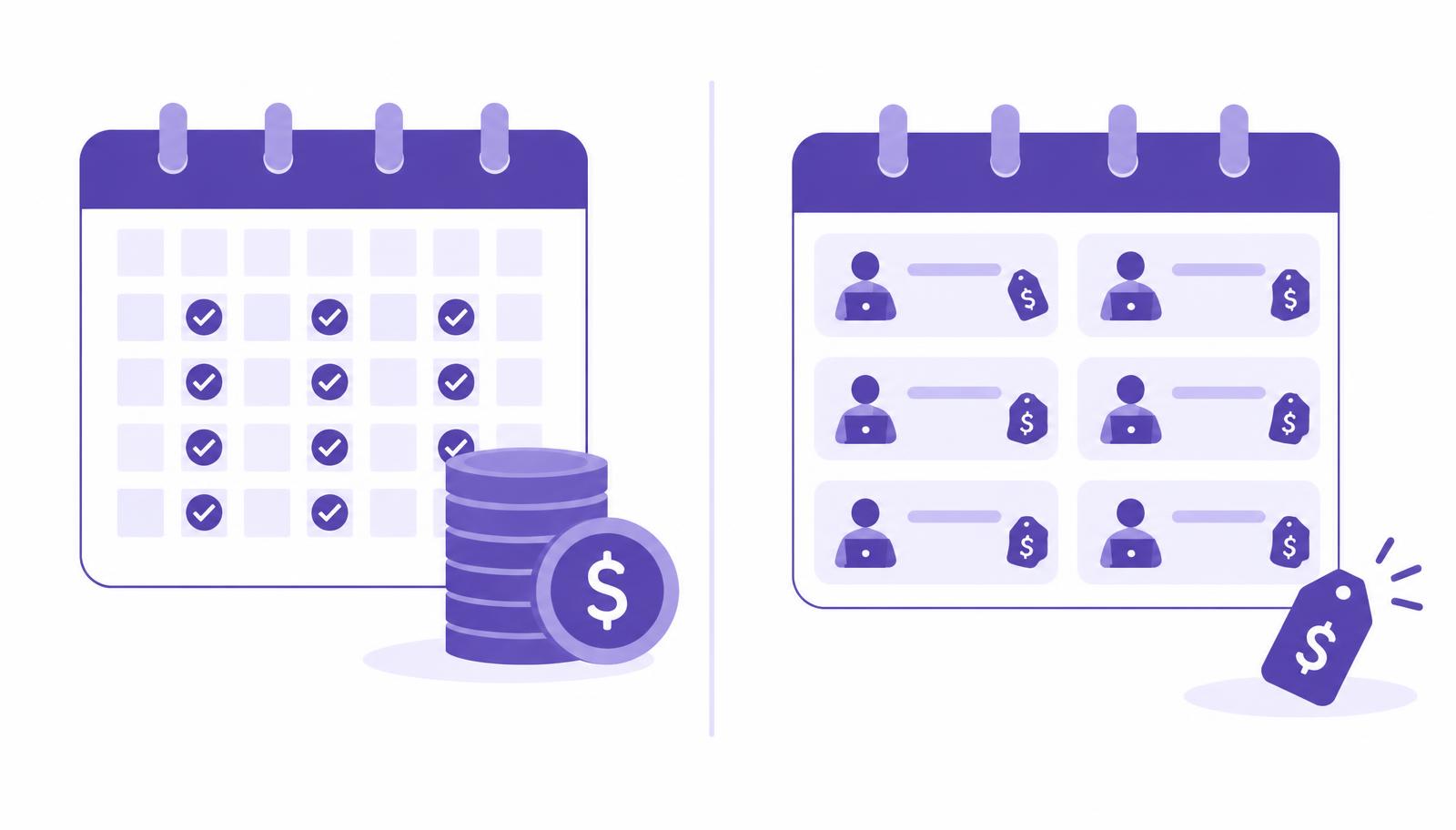
Quick answer: B2B lead generation services typically cost $3,000 to $15,000 per month for an outsourced agency, while pay-per-meeting services generally range from $150 to $1,000 per appointment, with enterprise-level meetings potentially costing more. Actual pricing depends on your target audience, outreach channels, qualification requirements, and whether you pay a monthly retainer or per booked meeting.
This guide is part of our outbound lead generation series. Outbound lead generation services: Prospect research, multi-channel outreach and qualified sales meetings.
The better question: what does a qualified conversation cost?
For most B2B companies, the better question isn't simply how much lead generation costs. It's how much the business pays to generate a qualified sales conversation that can realistically turn into revenue. A $300 meeting with an unqualified prospect may be more expensive than a $700 meeting with a decision-maker actively evaluating solutions.
In 2026, businesses increasingly evaluate outbound lead generation services on meeting quality, pipeline contribution, and customer acquisition economics rather than outreach volume alone.
Published pricing guides from SalesHive, Upcision, and other providers show significant variation across agency retainers and performance-based models. These are market estimates, not universal or guaranteed agency rates. For our earlier overview of pricing models, see How Much Does B2B Lead Generation Cost?.
B2B lead generation pricing comparison for 2026
• Monthly agency retainer: $3,000 to $15,000 per month. Best for consistent outbound pipeline development. • Pay-per-meeting: $150 to $1,000 per meeting. Best for businesses testing appointment volume. • Enterprise executive meetings: $800 to $2,500+ per meeting. Best for complex, high-value B2B sales. • Pay-per-lead: $25 to $500+ per lead. Best for lead acquisition and early funnel development. • Hybrid pricing: $2,000 to $4,000 base plus meeting fees. Shares fixed and performance-based costs. • In-house SDR: $8,000 to $14,500 per month fully loaded. Best for companies building internal sales infrastructure.
Sources: published 2026 market pricing from SalesHive, Newlead, Upcision, and Thinkable Group. Ranges are indicative, overlap across service categories, and are not EngageBizDev price quotes.
The lowest advertised price does not necessarily deliver the lowest customer acquisition cost. A B2B appointment setting agency that provides prospect research, personalized messaging, qualification, and sales handoff may generate fewer meetings but a stronger pipeline than a provider focused on calendar volume. For high-value services, SaaS, consulting, or complex B2B offerings, qualification quality can matter more to profitability than the initial price per meeting.
What are the main B2B lead generation pricing models?
Most outsourced lead generation companies use one of four commercial structures: monthly retainers, pay-per-meeting, pay-per-lead, or hybrid pricing. Each distributes financial risk differently between the agency and the client.
1. How does monthly retainer pricing work?
A monthly retainer is a fixed recurring fee for managing a defined outbound sales program. Rather than buying individual meetings, the business pays for an ongoing combination of services, which may include:
• Ideal customer profile (ICP) development and account targeting. • Prospect research, data enrichment, and contact verification. • LinkedIn sales prospecting and personalized outreach. • Cold email campaign creation and inbox management. • Multi-channel outbound sales coordination. • Reply management, prospect qualification, and appointment scheduling. • CRM updates, campaign reporting, and continuous optimization.
For example, a company paying $5,000 per month receives a defined program of prospecting and appointment-setting activity, whether that month generates 8 or 15 qualified meetings.
Advantages: predictable monthly spend, more flexibility to refine targeting and messaging, support for long-term pipeline acceleration, and better alignment with account-based prospecting and complex buying cycles.
Potential disadvantages: fees continue during slower months, results depend on execution quality, and the client must evaluate activity, meeting quality, and pipeline outcomes rather than relying on a meeting guarantee.
Best fit: B2B businesses seeking a scalable outbound strategy and ongoing sales development support.
2. How does pay-per-meeting lead generation work?
Businesses pay a fixed amount for each appointment. If a provider charges $400 per meeting and books 12 billable appointments, the monthly invoice is $4,800. The cost is tied to a measurable output, but there is an important distinction between a booked meeting and a qualified meeting that actually takes place. A meeting may be booked with someone who lacks purchasing authority, has no relevant problem, or never attends.
Before selecting a book-sales-meetings service, confirm whether the provider charges for:
• Any meeting added to the calendar. • Meetings that meet documented qualification criteria. • Meetings that are attended by the prospect. • Meetings with a verified decision-maker or buying influencer.
Advantages: direct relationship between bookings and fees, easier to test outbound without a large fixed commitment, and useful for companies with clear qualification criteria.
Potential disadvantages: incentives may favor volume over quality, meeting costs can rise for specialized audiences, and no-show policies and qualification disputes can create hidden costs.
Best fit: companies with validated offers, clear ICP definitions, and internal sales teams able to handle new opportunities.
3. What is pay-per-lead pricing?
Pay-per-lead charges for each contact that meets a specified lead definition. Depending on the provider, a lead could be a verified contact, an interested respondent, a marketing-qualified lead, or a sales-qualified lead. These are very different deliverables: 100 verified business contacts are not equivalent to 100 prospects who have expressed genuine interest.
A low-cost lead program can create substantial follow-up work for your sales team without producing meaningful revenue opportunities. For complex B2B sales, prioritize qualified B2B leads over raw database volume.
4. What is hybrid lead generation pricing?
Hybrid pricing combines a lower monthly retainer with a performance fee for each qualifying appointment. For example:
• Monthly base retainer: $2,500 • Qualified meeting fee: $250 • Meetings generated: 12 • Total monthly cost: $5,500
This balances the agency's operating costs with performance incentives. The contract must clearly specify what qualifies as a billable meeting and whether no-shows are replaced or refunded.
Retainer vs. pay-per-meeting: which is better for B2B companies?
Neither model is universally better. The right choice depends on deal value, market complexity, meeting volume, and growth stage.
• Monthly cost predictability: retainer high; pay-per-meeting depends on volume. • Initial financial commitment: retainer typically higher; pay-per-meeting can be lower. • Incentive to maximize bookings: retainer moderate; pay-per-meeting high. • Flexibility to test messaging: retainer often greater; pay-per-meeting depends on provider. • Complex account targeting: retainer often well suited; pay-per-meeting may carry premium fees. • Cost per meeting: retainer varies with output; pay-per-meeting is a fixed contracted rate. • Long-term optimization: retainer usually included; pay-per-meeting depends on contract. • Best use case: retainer for sustainable pipeline development; pay-per-meeting for defined appointment acquisition.
A retainer is often the better choice when you need more than appointments. A founder-led B2B consulting company entering a new market may need help identifying the right accounts, testing positioning, developing messaging, and building relationships with decision-makers.
Pay-per-meeting works well when you already understand your ideal customer, have a proven offer, and want to buy additional qualified conversations, or for short-term market testing. Either way, don't compare models solely by advertised rates. The meaningful comparison is cost per held, qualified meeting and the pipeline those meetings create.
How do you calculate the true cost per qualified B2B meeting?
Cost per qualified meeting = total outbound spend ÷ held qualified meetings. Consider two hypothetical providers:
• Agency A (retainer): $5,000 per month, 10 held qualified meetings = $500 per qualified meeting. • Agency B (pay per meeting): $4,800 for 12 bookings at $400 each, 7 held qualified meetings = $686 per qualified meeting.
Hypothetical scenario for comparison, not observed campaign performance; rounded to the nearest dollar. Although Agency B has a lower advertised price per booking, its effective cost per held qualified meeting is about 37% higher. That's why attendance rates, prospect fit, and qualification criteria should be central to any pricing discussion.
Quick estimate: with a $5,000 monthly budget, 12 booked meetings, an 80% attendance rate, and 80% of held meetings qualifying, you get about 7.7 qualified meetings, or roughly $651 per held qualified meeting. These are illustrative estimates only, and they exclude setup fees, sales team costs, and downstream conversions.
What factors influence B2B lead generation pricing?
1. How specific is your ideal customer profile? Targeting small business owners across a broad industry differs from identifying CFOs at enterprise software companies. Narrower markets need deeper research, more verification, and more personalized communication.
2. Which outreach channels are included? A cold email outreach agency may charge differently from a provider offering integrated email, LinkedIn, phone, video, and SMS. Multi-channel outbound needs more coordination and technology, but more channels don't automatically mean better results. The right mix depends on where your buyers are and how they prefer to engage.
3. How much personalization is required? Basic campaigns use segmented templates. More sophisticated programs use company-specific research, buying signals, and role-specific messaging. That takes more preparation time but improves relevance for high-value prospects.
4. What level of qualification is expected? Some providers deliver contact lists or interested replies. Others manage the full qualification process, handle objections, and schedule meetings with contextual notes, which costs more but reduces the burden on your sales team.
5. What technology and data costs are included? A full sales engagement stack may involve prospecting databases and enrichment, email verification, sending domains and inboxes, LinkedIn workflow tools, CRM integration, and deliverability monitoring. Before you sign, confirm whether these are included or billed separately.
Is outsourcing B2B lead generation cheaper than hiring an in-house SDR?
Outsourcing can be more cost-effective, especially for companies without the management infrastructure to run a dedicated SDR team. Published 2026 estimates put the fully loaded cost of an in-house SDR at about $8,000 to $14,500 per month. Salary is only one part; recruitment, onboarding, training, data, technology, management, and turnover all add up.
• Recruiting: in-house is your responsibility; an outsourced partner generally handles it. • Training: internal vs the provider manages its team. • Prospect research: internal or separately purchased vs often included. • Outreach technology: usually purchased separately vs may be included. • Sales management: internal manager required vs the agency manages delivery. • Scaling capacity: requires hiring vs depends on agency scope. • Process control: direct internal control vs contract and reporting based. • Institutional knowledge: retained internally vs requires documented handoffs.
An SDR outsourcing company can augment your sales team without building a full outbound department, which is especially relevant for startups, founder-led organizations, and businesses testing new markets. However, outsourcing isn't automatically cheaper. An established company with efficient processes and strong SDR management may get better economics in-house. Base the decision on fully loaded costs, meeting quality, and revenue contribution.
How much does LinkedIn lead generation cost compared with cold email?
A LinkedIn lead generation agency focuses on reaching decision-makers through profiles, connection requests, personalized messages, and ongoing relationship building. A cold email agency focuses on verified data, sequences, reply management, and deliverability.
• LinkedIn: strength is professional targeting and relationship building. Cost drivers are research, personalization, and account management. • Cold email: strength is scalable direct outreach. Cost drivers are data, inbox infrastructure, copywriting, and deliverability. • Phone outreach: strength is direct conversation and qualification. Cost drivers are calling capacity, training, and contact data. • Multi-channel: strength is coordinated engagement across touchpoints. Cost drivers are team capacity, tooling, orchestration, and reporting.
A scalable outbound strategy doesn't mean contacting more people. It means identifying the right accounts, communicating a relevant value proposition, and following up appropriately. For complex services, combining LinkedIn prospecting with personalized email and selective phone outreach can create more chances to engage buyers than relying on one channel.
How much should startups budget for B2B lead generation?
Early-stage businesses need to validate their target market and messaging before committing to large-scale prospecting. Prioritize learning which segments respond rather than maximizing volume. An illustrative budgeting framework:
• Early validation: $1,500 to $3,000 per month to validate ICP and messaging. • Early revenue growth: $3,000 to $6,000 per month to establish repeatable meetings. • Scaling B2B company: $6,000 to $10,000 per month to expand successful segments. • Established mid-market: $10,000 to $15,000+ per month to scale multiple outbound motions.
These are illustrative planning allocations, not verified market averages or minimum agency fees. Lower budgets may mean a narrower channel scope, founder-led execution, or a pilot. The key question is whether the business can profitably convert qualified conversations into customers. A fractional sales team or sales-development-as-a-service model can suit founders who need prospecting support but aren't ready to hire full-time SDRs.
How do you measure ROI from B2B lead generation services?
Connect campaign spend to revenue outcomes. Booked appointments alone don't give a complete picture. A useful framework:
• Cost per qualified meeting: total outbound spend divided by qualified meetings held. • Meeting-to-opportunity rate: share of qualified meetings that become genuine opportunities. • Opportunity-to-close rate: share of opportunities that become customers. • Customer acquisition cost: total acquisition spend divided by new customers. • Pipeline generated: total potential deal value of qualified opportunities. • Revenue generated: closed-won revenue attributable to the program.
Example: a hypothetical company invests $6,000 a month and holds 12 qualified meetings. With a 50% meeting-to-opportunity rate, a 25% opportunity-to-close rate, and a $20,000 average deal, it can expect 1.5 new customers, about $30,000 in closed-won revenue, a 5× revenue-to-spend ratio, and $4,000 of outbound spend per expected customer.
This is a hypothetical expected-value model. Actual customers are whole numbers, sales cycles may span months, and revenue is not profit. It excludes sales labor, fulfillment, and other acquisition costs. A lower-cost campaign that produces weak opportunities can underperform a more expensive one that consistently reaches high-value decision-makers.
What is the maximum you should pay for a qualified meeting?
A useful planning calculation: expected revenue per meeting = average deal value × meeting-to-close rate. If your average deal is $20,000 and 10% of held qualified meetings become customers, the expected revenue per meeting is $2,000.
That doesn't mean spending $2,000 to generate the meeting is profitable. Account for gross margin, closing costs, acquisition targets, and time to revenue. A more sustainable approach is to set your maximum acceptable customer acquisition cost and work backward to a target cost per qualified meeting.
What hidden costs should you watch for when hiring a lead generation agency?
The advertised fee may not be the full cost. Clarify:
• Setup and onboarding: one-time fee or included? • Prospect data: included or billed separately? • Email domains and inboxes: who pays and owns them? • LinkedIn tools: included in the service? • CRM integration: setup included or extra? • Meeting no-shows: replacement or refund policy? • Contract minimum: required duration and cancellation terms? • Campaign assets: who owns lists, messaging, and workflows?
A transparent agreement defines deliverables, reporting, qualification criteria, and responsibilities before launch, and states whether the provider guarantees activity, booked appointments, held meetings, or another outcome. These are not interchangeable commitments.
How do you choose the right B2B lead generation agency in 2026?
Choosing on price alone can create sales inefficiencies. Before selecting a provider, ask:
• How do you define a qualified sales meeting? • What research goes into identifying target accounts? • Which outreach channels will you manage? • How is messaging personalized for different buyer segments? • Who handles interested replies and objections? • What happens when a prospect cancels or fails to attend? • How do you report meeting quality, opportunities, and pipeline contribution? • Which costs are included in the monthly fee? • What happens to campaign data and assets when the contract ends? • How will you improve performance after the first 30 to 60 days?
An effective appointment setting agency can explain how it identifies prospects, qualifies interest, and transfers context to your sales team. The goal is not merely to fill calendars. It is to create sales conversations with a credible path to revenue.
Why EngageBizDev focuses on qualified meetings, not appointment volume
EngageBizDev's outbound approach is built around targeted prospect research, personalized outreach, and qualified sales conversations. Rather than treating every booked call as equally valuable, we use a qualification framework covering company fit, role fit, problem fit, timing, intent, and context. Appointment setting includes reply management, objection handling, scheduling, reminders, and sales handoff notes.
• Targeted prospecting: companies and decision-makers aligned with your ICP. • Personalized messaging: relevant outreach rather than generic high-volume sequences. • Multi-channel engagement: LinkedIn, email, phone, video, and SMS where appropriate. • Lead qualification: interest and fit checked before handoff. • Appointment coordination: scheduling, reminders, and meeting context. • Campaign optimization: targeting, messaging, and workflows refined from feedback.
EngageBizDev offers a monthly retainer tailored to your ICP, outreach scope, and growth objectives rather than a universal fixed price, which suits founder-led and growing B2B companies that need structured outbound without building a full internal sales development department.
Final thoughts: what should you pay for B2B lead generation in 2026?
Pricing ranges from inexpensive lead acquisition to comprehensive outbound partnerships costing thousands per month. Retainers give a predictable structure for ongoing prospecting and optimization. Pay-per-meeting ties cost to appointments but needs careful qualification and attendance policies. The best choice depends on your business model, deal value, sales capacity, and growth goals.
The most important metric is not how cheaply you can book a meeting. It is how efficiently you can generate qualified conversations that turn into revenue.
Frequently asked questions
How much does B2B lead generation cost per month in 2026?
Outsourced B2B lead generation programs commonly cost $3,000 to $15,000 per month, depending on channels, research, personalization, and qualification. Specialized enterprise programs may exceed this, while smaller, limited-scope campaigns can cost less.
Is pay-per-meeting cheaper than a monthly retainer?
It can be cheaper when appointment volume is low, but it is not necessarily more cost-effective. Compare both models using total cost per held qualified meeting rather than the advertised price per booking.
What is a reasonable cost per qualified B2B appointment?
Published 2026 pricing guides commonly place standard B2B appointments around $150 to $500, with more qualified or senior-level meetings costing considerably more, depending on seniority, market difficulty, deal value, attendance, and how qualification is defined.
How much does it cost to outsource an SDR?
An outsourced SDR program may cost several thousand dollars per month, depending on team structure and scope. A fully loaded internal SDR can cost about $8,000 to $14,500 monthly. Compare total delivery costs and meeting outcomes, not salary alone.
Is LinkedIn lead generation more expensive than cold email?
LinkedIn can need more manual research and relationship building, while cold email carries data, inbox, and deliverability costs. Neither is universally cheaper; it depends on scope, audience, volume, and whether the agency handles qualification and scheduling.
How long does outsourced B2B lead generation take to produce results?
Initial meetings may appear within the first few weeks, but predictable pipeline takes continued testing and optimization. Timing depends on the ICP, offer, readiness, and buying cycle. Early appointments shouldn't be confused with closed-won revenue.
What is the best lead generation pricing model for startups?
Startups with limited budgets and clear qualification requirements may prefer pay-per-meeting or a small pilot. Companies wanting continuous prospecting, message testing, and pipeline development may benefit from a monthly retainer.
How do I know if my lead generation agency is worth the cost?
Measure cost per held qualified meeting, meeting-to-opportunity conversion, pipeline value, and closed-won revenue, plus prospect fit, sales feedback, and reporting transparency. An agency delivers value when it contributes to profitable customer acquisition, not just more activity.
Stop reading. Start booking.
Want EngageBizDev to run this for you?
Book a 20-minute call with Kelly. She'll look at your current outbound and tell you honestly what she'd change.
Book a Strategy Call